
EUR/USD: Comprehensive Review and Outlook
EUR/USD has broken above the descending channel that contained every rally since 2008—a generational technical shift. However, potential near-term dollar strength and a formidable resistance cluster at 1.22-1.25 could delay the medium-term bullish case.
✅ Last Reviewed: | 📝 Last Updated: | 📋 Full History →
EUR/USD at a Glance
Directional Pressure on EUR/USD:
European growth stagnation and political fragmentation weigh on the euro
🌎 GLOBAL FACTORSPossible short-term dollar strength ahead, but structural dollar weakness favors medium-term recovery
🧠 SENTIMENT & POSITIONINGDollar overvaluation consensus, though not extreme, favors EUR/USD recovery.
📈 TECHNICAL STRUCTURE17-year descending channel broken; constructive consolidation above breakout
🎯 FINAL VERDICTStrategic (medium/long term)
Channel breakout and structural dollar weakness favor recovery, though euro fundamentals remain the weak link.
Tactical (near term)
Potential dollar rally and 1.22-1.25 resistance cluster likely cap upside over next 2-3 months.
〰️ Forces Shaping EUR/USD
EUR/USD faces a tactical-strategic disconnect in early 2026. Near-term headwinds are stacking up: a potential dollar rally, European growth stagnation, and elevated political fragmentation risk all pressure the pair lower. However, the medium-term picture is more constructive—the structural dollar downtrend since late 2022 is likely to resume at some point, and slight ECB-Fed policy divergence is not wide enough to sustain persistent euro weakness.
| Component | Current Assessment |
|---|---|
| ECB VS FED POLICY DIVERGENCE |
Slight divergence creates modest headwind, but not dominant
|
| EUROPEAN GROWTH OUTLOOK |
Stagnation weighs on the euro without providing a recovery catalyst
|
| EUROPEAN POLITICAL RISK |
Active fragmentation risk weighs on euro sentiment
|
| BROADER USD DYNAMICS |
Possible near-term dollar strength warrants caution and patience on EUR/USD longs
|
🧠 Sentiment & Positioning
Fund manager sentiment is rotating away from dollar dominance and toward a more constructive euro outlook. The shift is meaningful but not extreme—positioning favors EUR/USD recovery over the medium term while leaving room for near-term dollar strength to play out first.
| Component | Current Assessment |
|---|---|
| Bank of America Global Fund Manager Survey Jan 2026 |
Dollar overvaluation consensus and positioning rotation favor EUR/USD recovery
|
📈 Technical Structure
Technical structure has shifted constructively after EUR/USD broke above the descending channel that contained every rally since 2008. However, the pair now faces a cluster of horizontal resistance levels that will determine whether this breakout evolves into a sustained trend change or stalls into a failed breakout.
| Technical Factor | Current Status | Structural Signal |
|---|---|---|
| LONG-TERM DESCENDING CHANNEL (2008-2025) | Decisive breakout above upper boundary after 17 years of containment |
Generational trend change — structural downtrend ended
The descending channel that contained every major rally since 2008 has been broken. This shifts the technical regime from "rally within a downtrend" to "potential new uptrend." |
| HORIZONTAL RESISTANCE CLUSTER (1.22-1.25) | Approaching multi-cycle resistance zone that capped advances in 2021 and 2025 |
Formidable overhead supply likely to cap near-term upside
The 1.22 pivot and 1.25 structural level have repeatedly marked the ceiling for EUR/USD across multiple cycles. Clearing this zone would confirm the channel breakout; rejection would risk a failed breakout and return to range dynamics. |
| POST-BREAKOUT CONSOLIDATION (1.16-1.20) | Sideways range above the broken channel boundary since mid-2025; holding gains |
Constructive base-building favors eventual upside resolution
Price is consolidating above the broken channel rather than reversing back into it—a pattern typical of post-breakout digestion phases. Support at 1.15-1.18 has held on repeated tests, while probes toward 1.20-1.21 show selling interest without producing reliable reversal signals. |
| CANDLESTICK BEHAVIOR | Long upper shadows near 1.2072; bullish absorption absent at current levels |
Selling interest near 1.20-1.21, but lacks reversal significance
Two long upper shadows have formed near 1.2072, but both occurred within a sideways range rather than following an extended uptrend—reducing their weight as reversal signals. They indicate supply near round-number resistance rather than exhaustion of a directional move. |
Monthly Chart — Channel Breakout and Horizontal Resistance Test
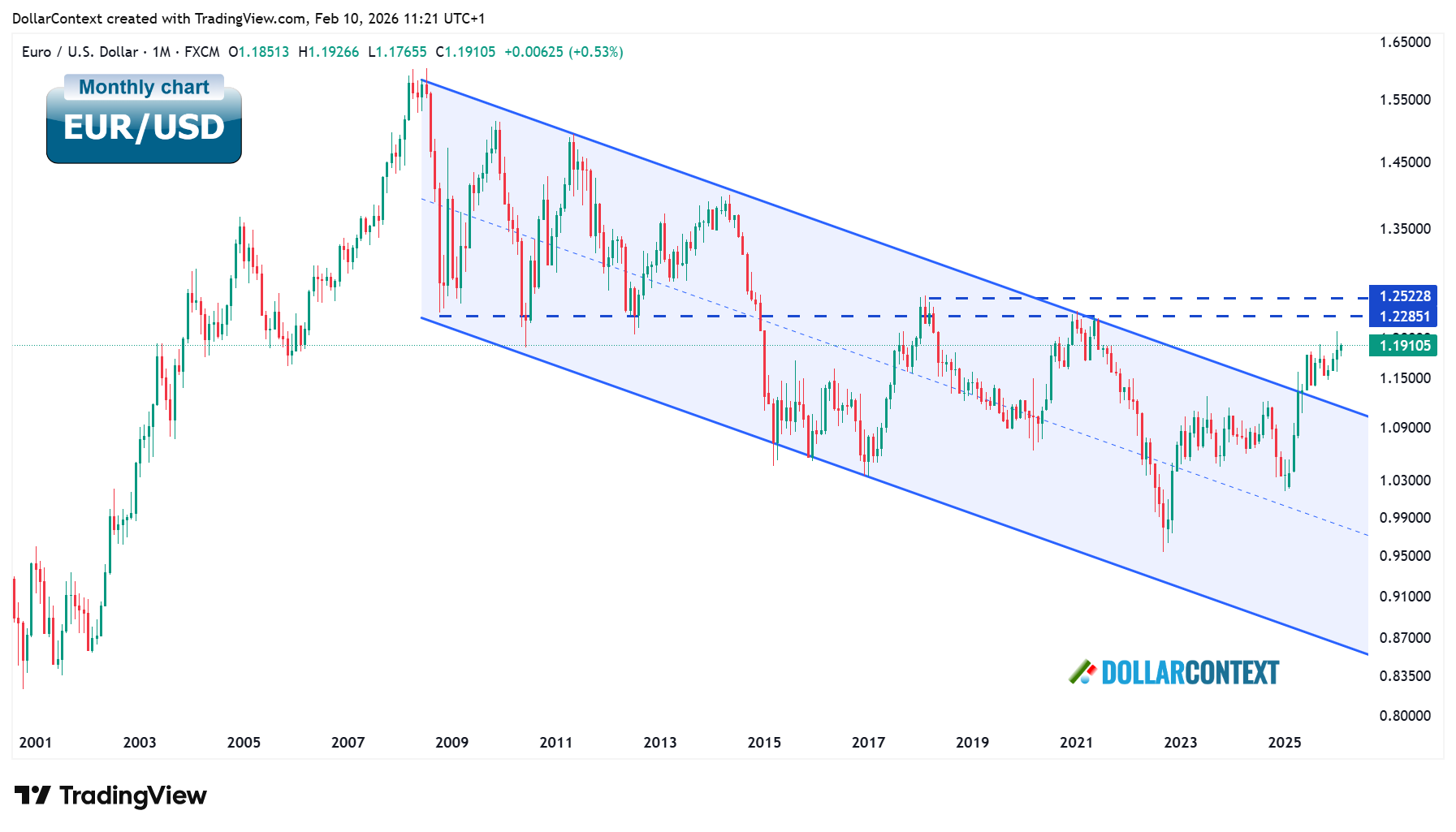
Since the highs above 1.60 in 2008, EUR/USD has traded within a descending parallel channel that has defined the pair's structural trajectory for nearly two decades. After approaching the lower boundary near parity in 2022, the pair has recovered steadily and broken decisively above the upper channel boundary. Now it's trading near a cluster of horizontal resistance levels.
Descending channel breakout
The breakout above the upper channel boundary is a significant structural event. This descending channel contained every major EUR/USD rally since 2008—including the 2011, 2014, 2018, and 2021 advances, all of which stalled at or near the upper boundary. The decisive break above it suggests the 17-year downtrend structure has ended, shifting the technical regime from "rally within a downtrend" to "potential new uptrend."
Current test: horizontal resistance confluence at 1.22-1.25
With the channel breakout behind it, EUR/USD now faces the next structural hurdle—a cluster of horizontal resistance levels that have defined the pair's ceiling across multiple cycles:
1.22 pivot level: 1.22 pivot level: This level has acted as both support and resistance since 2008, serving as a recurring inflection point. It also aligns with BofA survey participants’ year-end target, suggesting that the market broadly expects this level to be tested.
Key takeaway (monthly chart)
The monthly chart shows a generational technical shift: EUR/USD has broken above the descending channel that contained every rally since 2008. However, the breakout now faces a cluster of horizontal resistance at 1.22-1.25 that has repeatedly capped advances. Price at ~1.19 has room to move higher but must clear this zone to confirm the structural trend change. A rejection at 1.22-1.25 would risk a failed breakout and return to range dynamics.
Weekly Chart — Channel Breakout and Consolidation Near Resistance

The weekly chart details how EUR/USD's recovery from the late 2024 lows near 1.03-1.04 accelerated into a decisive breakout above the long-term descending channel, followed by consolidation near the 1.18-1.19 zone.
Recovery and channel breakout (late 2024–mid 2025)
The rally from late 2024 was sharp and sustained, carrying EUR/USD from below 1.04 through the descending channel's upper boundary in early-to-mid 2025. The breakout was clean—price moved through the boundary without extended hesitation—and the channel line has not been retested since.
Consolidation near 1.18-1.19 (mid 2025–Present)
Since breaking the channel, EUR/USD has entered a sideways consolidation roughly between 1.16 and 1.20:
- Horizontal support at 1.18-1.1835: This zone has been tested repeatedly throughout the consolidation and has held, establishing a clear near-term floor. The dashed horizontal reference at this level aligns with prior price action, reinforcing its significance.
- Upper boundary probes toward 1.20-1.2072: Price has reached toward the 1.20-1.21 area on two occasions, producing long upper shadows. However, these formations occurred within a sideways range rather than following an extended uptrend—reducing their significance as reversal signals.
- Consolidation character is constructive: The range is forming above the broken channel boundary, which is typical of a post-breakout digestion phase. Price is holding its gains rather than reversing back into the channel—a pattern that generally favors eventual resolution higher.
Key takeaway (weekly chart)
The weekly chart confirms the monthly channel breakout and shows a constructive consolidation phase above the broken boundary. EUR/USD is building a base in the 1.16-1.20 range, with 1.18-1.1835 acting as near-term support and the 1.20-1.21 area as the immediate hurdle. The long upper shadows near 1.2072 warrant monitoring but lack the directional context that would make them reliable reversal signals. A breakout above 1.21 would open the path toward the monthly resistance cluster at 1.22-1.25, while a break below 1.16 would threaten the consolidation structure and raise questions about the channel breakout's sustainability.
🎯 Final Verdict
Our comprehensive analysis across four key dimensions—domestic drivers, global factors, technical structure, and positioning—reveals a pair at a structural inflection point. The breakout above a 17-year descending channel is a generational technical shift, but near-term headwinds from potential short-term dollar strength, European growth stagnation, and political fragmentation risk are likely to delay the medium-term bullish case.
Medium/Long-Term Outlook
The channel breakout changes the structural picture. EUR/USD has broken above the descending channel that contained every rally since 2008. This shifts the technical regime from a multi-decade downtrend to a potential new uptrend—the most significant structural development for the pair in years.
Structural dollar weakness is the primary tailwind. The broader dollar downtrend since late 2022, driven by fiscal concerns and safe-haven erosion, is likely to resume.
European fundamentals remain the weak link. Growth stagnation, elevated political fragmentation risk, and slight ECB-Fed policy divergence prevent the euro from rallying on its own merits. The bullish case depends more on dollar weakness than euro strength—making it vulnerable if the structural dollar decline stalls.
Near-Term Tactical View
Potential dollar rally creates a 2-3 month headwind. Technical and cross-asset signals suggest a possible dollar rebound toward DXY 104-106, which would pressure EUR/USD lower and likely delay any test of the 1.22-1.25 resistance cluster. This counter-trend move needs to play out before the structural bullish case can reassert.
Horizontal resistance at 1.22-1.25 caps near-term upside. Even without dollar strength, the multi-cycle resistance cluster at 1.22-1.25 represents formidable overhead supply. Clearing this zone requires fundamental catalysts—such as European growth improvement or accelerated Fed easing—that are not yet in place.
Consolidation above the breakout is the constructive scenario. If EUR/USD holds the 1.15-1.18 support zone during any dollar-driven pullback, the post-breakout structure remains intact and the pair would be well-positioned to challenge resistance once the tactical headwinds fade. A break below 1.15, however, would threaten the breakout's validity and shift the outlook from "delayed rally" to "failed breakout."
📝 Update History
- February 9, 2026: Initial publication
This analysis reflects market conditions and information available at the time of publication. It is provided for informational and educational purposes only and does not constitute financial, investment, or legal advice.
The financial markets are inherently volatile, and past performance is never a guarantee of future results. Readers should conduct their own independent research or consult with a licensed professional before making any investment decisions. Any actions taken based on the content of this report are at the sole discretion and risk of the reader, and the author assumes no liability for any potential losses or damages.