
USD/JPY: Comprehensive Review and Outlook
USD/JPY remains range-bound as a wide rate differential supports elevated levels, but BOJ normalization, fragile carry dynamics, and intervention risk are eroding the upside. Near-term dollar strength may lift the pair, but the margin of safety is thinning.
✅ Last Reviewed: | 📝 Last Updated: | 📋 Full History →
USD/JPY at a Glance
Directional Pressure on USD/JPY:
Rate differential still wide, but BOJ normalization meaningfully narrowing the gap
🌎 GLOBAL FACTORSCarry trade supportive but fragile; intervention risk caps upside
🧠 SENTIMENT & POSITIONINGStrong bearish consensus on USD/JPY, not yet extreme enough for contrarian reversal
📈 TECHNICAL STRUCTURERange-bound between 150-152 support and 162-165 resistance; bullish absorption at lows
🎯 FINAL VERDICTStrategic (medium/long term)
Rate differential still supports elevated levels, but BOJ normalization, carry fragility, and intervention risk are eroding the advantage.
Tactical (near term)
Short-term technicals, a potential tactical dollar rally, and premature bearish positioning favor USD/JPY upside over the next 2–3 months.
〰️ Forces Shaping USD/JPY
From a macro perspective, USD/JPY faces competing pressures in early 2026. While the rate differential remains wide and a potential short-term dollar rally provides near-term support, structural forces are shifting: BOJ normalization is gradually narrowing the yield gap, carry trade unwind risk is growing, and Japanese authorities are actively defending against further yen weakness. The balance of forces still favors elevated USD/JPY, but the margin of safety is thinning.
| Component | Current Assessment |
|---|---|
| FED VS BOJ RATE DIFFERENTIAL |
Still wide enough to support elevated USD/JPY
|
| BOJ POLICY NORMALIZATION |
Meaningful tightening is narrowing the yield gap
|
| CARRY TRADE DYNAMICS |
Still supportive, but unwind risk is growing
|
| JAPANESE INTERVENTION RISK |
Authorities actively defending against further yen weakness
|
| BROADER USD DYNAMICS |
Potential short-term dollar rally provides near-term support
|
| RISK SENTIMENT & SAFE-HAVEN FLOWS |
Yen's safe-haven role creates latent downside risk for USD/JPY
|
🧠 Sentiment & Positioning
Fund manager sentiment has shifted decisively toward yen strength in 2026, with the JPY voted the most likely currency to outperform. However, the expected move is a controlled appreciation rather than a disorderly crash—creating a consensus view that is itself vulnerable to surprise in either direction.
| Component | Current Assessment |
|---|---|
| Bank of America Global Fund Manager Survey Jan 2026 |
Strong bearish consensus on USD/JPY, but not extreme enough to signal contrarian reversal
|
| DAILY NEWS SENTIMENT INDEX (DNSI) |
Neutral sentiment provides no strong directional signal
|
📈 Technical Structure
Technical structure is range-bound and directionally neutral, with USD/JPY trading between well-defined horizontal boundaries. Bullish absorption patterns near support suggest buying interest at lower levels, but the pair has yet to break decisively in either direction. The following analysis examines monthly and weekly charts to assess whether this consolidation resolves higher or lower.
| Technical Factor | Current Status | Structural Signal |
|---|---|---|
| HORIZONTAL RANGE STRUCTURE | Trading mid-range between 150-152 support and 162-165 resistance |
Range-bound, no directional resolution yet
USD/JPY is contained within a well-defined horizontal range. Both boundaries have been tested and defended, reflecting a market that is absorbing competing forces—dollar strength and rate differential support versus BOJ normalization and intervention risk—without committing to a direction. |
| KEY SUPPORT ZONE (150-152) | Bullish candle confirm buying absorption |
Strong structural floor with active demand
The 150-152 zone has proven to be a key support area, with bullish reversal signals on a range of occasions. This absorption behavior suggests institutional buying interest at these levels, consistent with the still-wide rate differential. |
| KEY RESISTANCE ZONE (162-165) | Multiple approaches have stalled; no decisive breakout |
Firm ceiling reinforced by intervention risk
Rallies toward 162-165 have consistently failed to sustain momentum. This resistance is reinforced by the threat of Japanese intervention, which creates a psychological and practical ceiling. Until intervention risk diminishes or a powerful catalyst emerges, upside beyond this zone appears limited. |
| CANDLESTICK BEHAVIOR | Weekly candle with long lower shadow near 150–152 support |
Buying interest at support favors upside bias within range
The asymmetry in candlestick behavior—bullish patterns forming near support with no equivalent bearish reversal signals at resistance—suggests the range is more likely to resolve toward its upper boundary. However, this remains a range-trading signal rather than a breakout signal. |
Monthly Chart — Multi-Decade Breakout and Elevated Consolidation
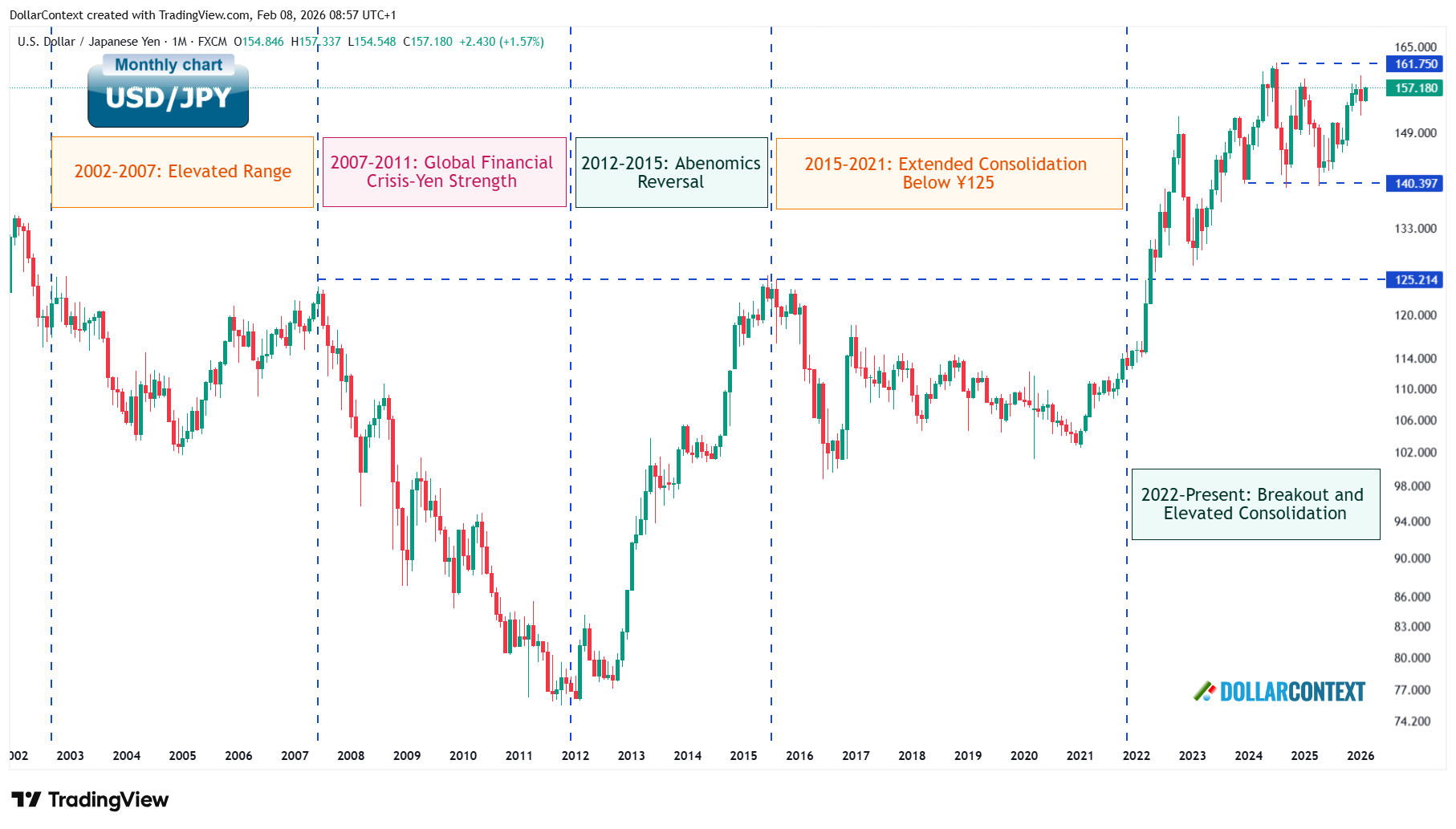
Since 2002, USD/JPY has been shaped by five structural regimes driven by shifts in monetary policy divergence, safe-haven flows, and intervention dynamics. The dominant feature of the current era is the 2022 breakout above the ¥125 ceiling that had capped price action for nearly two decades.
Summary of major USD/JPY regimes
- 2002–2007: Elevated Range — USD/JPY traded between ¥105-¥125, supported by a relatively strong dollar and wide rate differentials before the global financial crisis disrupted the carry trade framework.
- 2007–2011: Crisis-Driven Yen Strength — Safe-haven repatriation flows and risk aversion drove a dramatic yen rally from ¥124 to ¥75, as the global financial crisis and subsequent deleveraging unwound carry positions and redirected capital into Japanese assets.
- 2012–2015: Abenomics Reversal — The Bank of Japan's unprecedented monetary easing under Abenomics drove a sharp reversal from ¥75 back to the ¥125 ceiling, effectively retracing the entire crisis-era yen strengthening in three years.
- 2015–2021: Extended Consolidation Below ¥125 — USD/JPY oscillated between ¥100-¥125, with the multi-decade resistance ceiling repeatedly capping advances. Despite periodic volatility, the pair remained structurally range-bound as BOJ policy reached its limits and global rates stayed compressed.
- 2022–Present: Breakout and Elevated Consolidation — Explosive move above the ¥125 ceiling driven by the widest Fed-BOJ rate differential in decades. USD/JPY surged to ¥161.75 before volatile consolidation between ¥140-¥162, shaped by intervention episodes, carry trade dynamics, and the early stages of BOJ normalization.
Current Phase: Breakout and Elevated Consolidation (2022–Present)
- Multi-decade breakout above ¥125 remains intact: The decisive move above the resistance ceiling that contained USD/JPY from 2002 through 2021 represents a structural regime change. Despite sharp intervention-driven pullbacks, price has consistently held well above this former resistance, confirming the breakout's validity.
- ¥140 as the new structural floor: Each major correction since the breakout—including the sharp intervention episodes—has found support near ¥140, establishing this level as the effective floor of the new elevated range.
- Intervention creates volatility, not trend change: The extremely long lower shadows visible on several monthly candles reflect Japanese intervention episodes that produced dramatic intra-month spikes but failed to reverse the broader trend. Authorities have succeeded in slowing the pace of yen weakening but not in reversing the structural move.
- Consolidation near the highs favors eventual resolution higher: USD/JPY is trading at ¥157, near the top of its post-breakout range. The ability to maintain these elevated levels despite intervention, BOJ hikes, and periodic risk-off episodes suggests the rate differential continues to dominate price action.
From a structural perspective, the monthly chart is defined by the 2022 breakout above the ¥125 ceiling—a level that constrained price for nearly two decades. As long as USD/JPY holds above this former resistance, the long-term regime shift toward elevated levels remains intact.
Key takeaway (monthly chart)
USD/JPY's monthly structure confirms a multi-decade regime change. The ¥125 breakout, ¥140 structural floor, and ability to consolidate near highs despite intervention and BOJ tightening all point to continued dollar strength against the yen—though the narrowing rate differential and escalating intervention risk suggest upside is increasingly capped near ¥161-¥162 rather than open-ended.
Weekly Chart — Wide Range Consolidation With Bullish Recovery Signal
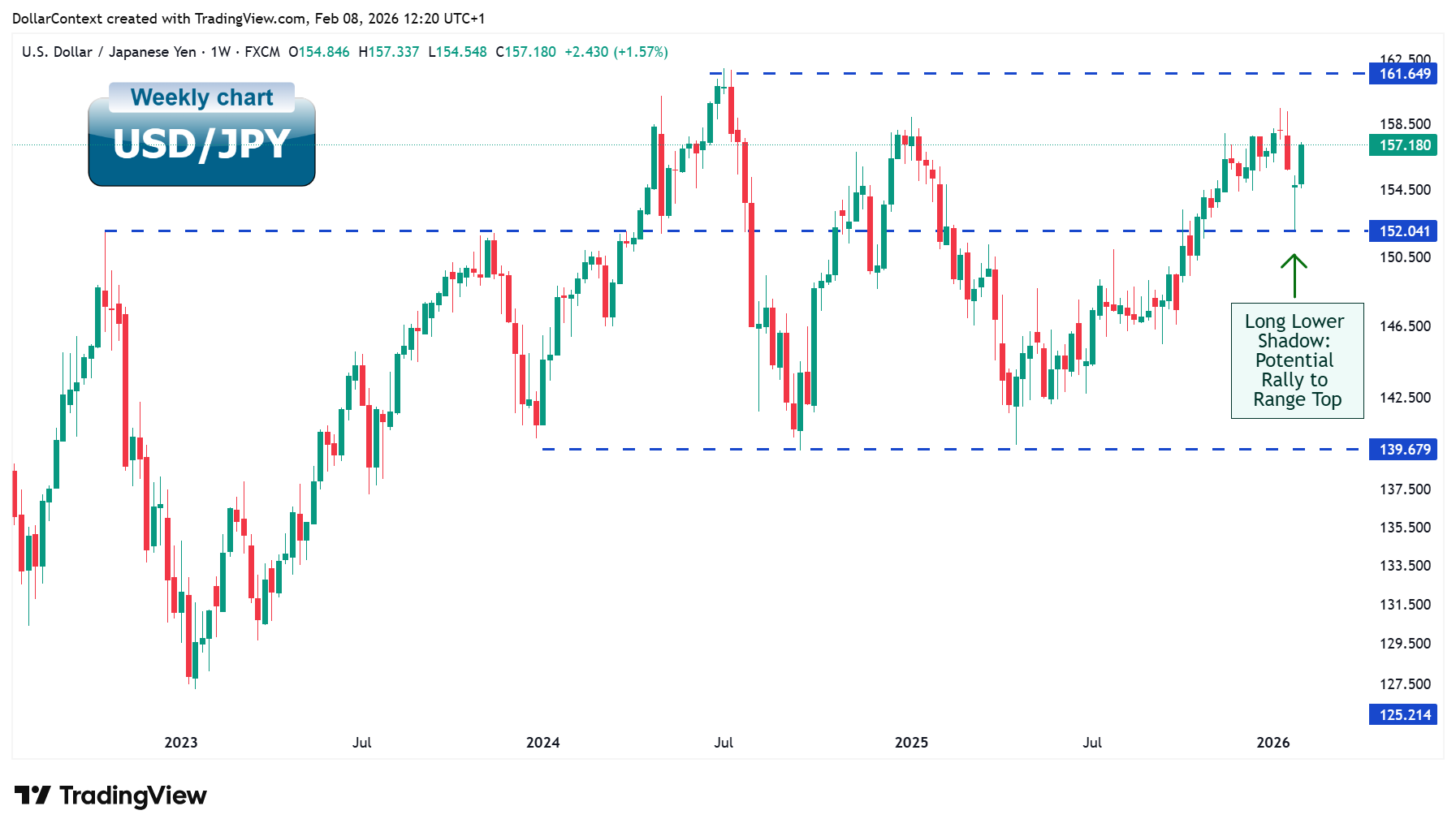
The weekly chart reveals how USD/JPY has consolidated within a wide ¥140-¥162 range since mid-2023, with sharp intervention-driven selloffs consistently absorbed by buyers near the range floor.
Range structure (mid-2023–present)
After the initial surge from ¥115 to ¥152 in 2022 and subsequent pullback, USD/JPY has established a well-defined consolidation range between approximately ¥140 and ¥162:
- ¥161-¥162 as firm resistance ceiling: Multiple attempts to break above this zone have been rejected, most notably the July 2024 peak at ¥161.65. This level represents the upper boundary that has consistently capped advances.
- ¥140 as durable range floor: Each major selloff—whether driven by intervention, carry trade unwind, or risk-off episodes—has found support near ¥140. The speed and consistency of recoveries from this level suggest strong structural buying interest.
- V-shaped recoveries define the pattern: Rather than gradual bottoming processes, corrections to the ¥140 area have produced sharp, V-shaped rebounds back toward the range highs. This behavior reflects the persistent force of the rate differential pulling price back toward the upper end of the range.
Recent bullish signal: long lower shadow
The most recent weekly price action has produced a notable long lower shadow after a pullback toward ¥150, suggesting renewed buying absorption and a potential rally back toward the range top.
Key takeaway (weekly chart)
The weekly structure shows a well-established ¥140-¥162 range where dips are bought aggressively and rallies stall at the intervention-defended ceiling. The recent long lower shadow suggests another move toward the range top is likely, though breaking above ¥162 requires a shift in the intervention dynamic or a material widening of rate differentials that appears unlikely given BOJ normalization. The range remains the dominant structure until one boundary gives way decisively.
🎯 Final Verdict
Our comprehensive analysis across four key dimensions—domestic drivers, global factors, technical structure, and positioning—reveals a pair caught between near-term dollar support and growing structural headwinds from BOJ normalization, carry trade fragility, and active intervention risk.
Medium/Long-Term Outlook
The rate differential still favors USD/JPY, but the advantage is eroding. The gap between U.S. and Japanese policy rates remains wide, but BOJ hiking is no longer symbolic—it is meaningfully narrowing the yield spread that has underpinned yen weakness since 2022. Each additional hike compresses the carry advantage that supports elevated levels.
Intervention risk caps upside and creates asymmetric exposure. Japanese authorities are actively defending against further yen weakness, with verbal warnings at levels that preceded direct action in prior episodes. This effectively limits USD/JPY upside near current levels while leaving the door open to sharp downside if intervention materializes.
Carry trade positioning is increasingly fragile. The trade remains positive but crowded, with unwind triggers multiplying as BOJ normalizes and the differential narrows. A disorderly liquidation—while not the base case—could produce outsized yen strengthening in a compressed timeframe.
Near-Term Tactical View
Potential dollar rally provides a near-term tailwind. Technical and cross-asset signals suggest a possible 2-3 month dollar rebound toward DXY 104-106, which would support USD/JPY in the near term and delay the structural yen appreciation that managers are positioning for.
Fund manager consensus may be premature. Strong bearish positioning on USD/JPY—with 30% naming the yen as the top currency for 2026—creates vulnerability to a squeeze if dollar strength materializes before BOJ convergence plays out. The consensus expects a controlled yen appreciation, but timing matters: if the dollar rallies first, crowded yen longs face near-term pain.
Structural headwinds are real but not yet dominant. BOJ normalization and intervention risk are growing forces, but neither has reached the tipping point needed to override the still-wide rate differential and near-term dollar support. The balance favors USD/JPY holding or moving modestly higher over the next 2-3 months before structural forces reassert.
📝 Update History
- February 8, 2026: Initial publication
This analysis reflects market conditions and information available at the time of publication. It is provided for informational and educational purposes only and does not constitute financial, investment, or legal advice.
The financial markets are inherently volatile, and past performance is never a guarantee of future results. Readers should conduct their own independent research or consult with a licensed professional before making any investment decisions. Any actions taken based on the content of this report are at the sole discretion and risk of the reader, and the author assumes no liability for any potential losses or damages.